
The Sound of John Taylor & Co.
The Sound of John Taylor & Co.
“”
For over a century, John Taylor & Co. has cast some of the world’s most iconic and sonorous bells — instruments that speak not only in tone, but in heritage.
This page offers a rare opportunity to hear the living legacy of Taylor bells, recorded in situ at some of Britain’s most remarkable churches and cathedrals.
From the thunderous voice of Great Peter at York Minster, to the intricate rhythms of Stedman Triples, to the unexpected journey of the Nelson chime, and the expressive elegance of a modern carillon, each recording showcases the unique tonal beauty and enduring craftsmanship that define a Taylor bell. The final piece, performed on handbells, is a specially composed anthem by Sophia Dady, celebrating the spirit and story of John Taylor & Co. in music.
Bourdon Bells, Chimes, Carillons & Handbells
Great Peter
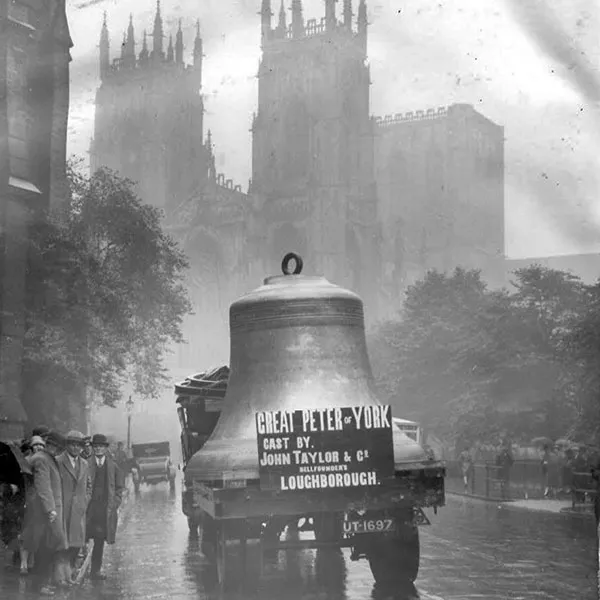
Over the past century, more than 200 bells weighing over 2 tons each have been cast by Taylor’s, one of the most renowned bell foundries in the world. Among these giants is the magnificent Great Peter of York, which was cast in 1927 and tips the scales at an impressive 11 tons. This monumental bell is hung for slow swinging and also serves a prestigious dual role: it is the hour bell of the grand clock chime at York Minster. Notably, this chime boasts the deepest tone of any clock chime in Great Britain, adding a powerful and solemn resonance to the historic cathedral’s soundscape. Great Peter remains both a marvel of craftsmanship and a cherished symbol of York’s rich musical and architectural heritage.
Play Great Peter sound

Bells on the Move
These hymns are being rung on a historic chime of bells originally cast by Taylor’s in 1933 for St Mary’s Parish Church in Nelson, Lancashire. Interestingly, before being installed in the church tower, the bells were temporarily loaned to the famed showman Billy Butlin. They were hung at his newly opened holiday camp in Skegness, Lincolnshire, where they featured in vibrant carnival celebrations held in September 1933 — a unique detour in their journey. After their return and installation at St Mary’s, the bells served the parish for several decades. When the church eventually closed, the bells were purchased and brought to York Minster, where they continue to sound out across the city, preserving their legacy in a new sacred setting.
Play bell sound
Carillon – La Vie en Rose
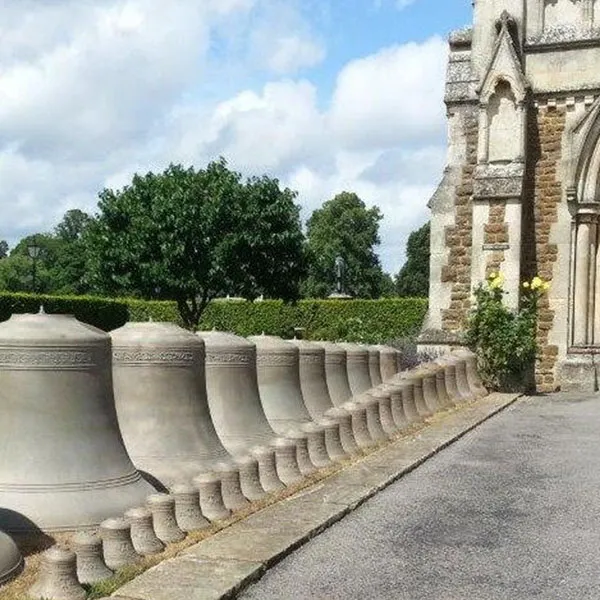
Here, La Vie en Rose is performed on the York Minster carillon by Eddie Marien of Mechelen, Belgium — a city renowned for its carillon tradition. The foundation of this instrument is the original Nelson chime of eleven bells, cast in 1933 by Taylor’s. In 2007, an additional 24 bells were commissioned and cast by the same foundry to expand the instrument into a fully chromatic carillon of 35 bells. This blend of historical and modern craftsmanship allows for both traditional hymns and expressive melodies like La Vie en Rose to resonate through the Minster’s vast stone spaces — a fusion of English bell-ringing heritage and European carillon artistry.
Play Carillon sound
John Taylor Bell Foundry Anthem
When the major renovation project was completed in 2024—thanks to the National Lottery and other generous donors—a unique anthem was specially composed for John Taylor & Company: the John Taylor Bell Foundry Anthem. It marks the first time the bellfoundry has had its own dedicated anthem—history in the making for this historic place!
Composed by Sophia Dady, she writes: “It has been such a pleasure and an honour to be asked to create this very special piece. I hope, as a listener or player, you can feel the magic of this remarkable foundry as the bells proudly call out to all, near and far.”
Peals of 10 & 12 Bells

Abergavenny, Gwent
The bells featured in the next track are Abergavenny in Gwent, which have a reputation as one of the finest sounding 10s in the country. The old 8 were re-cast in 1947 with the exception of the 6th which was retained and kept in the church and a new bell was cast in its place. Two trebles were added at the same time to create this peal.
The band’s ringing 4 leads of Spliced Royal consisting of Yorkshire Surprise, Little Bob, Little Bob and Cambridge Surprise. The recording starts off outside and moves inside to get a flavour of what the ringers hear.
Play Abergavenny, Gwent

Oxford, Oxfordshire
This is St. Thomas, Oxford. This peal of bells evolved from the old ring of 6 throughout the 1990s. They set a benchmark for peals of bells of this size and prove their popularity by having had over 30 peals a year rung on them since 1996. The proximity to the tower of the railway station explains the sound of the passing trains.
The band’s ringing 3 leads of Surprise Royal consisting of Littleport, Yorkshire and Littleport.
Play Oxford, Oxfordshire

Loughborough, Leicestershire
And so to home. The final track features the bells of Loughborough Parish Church. Taylors were awarded the contract to recast the bells in 1839 on condition that they move to Loughborough. After augmentation for Queen Victoria’s Jubilee, the bells were recast just a decade later because of the revolution in the quality of bells we were able to achieve. The back 4 are lost wax castings and have intricate patterns on them.
The band is ringing a touch of Stedman Caters.
Play Loughborough, Leicestershire

Towcester, Northamptonshire
The next track features the peal of 12 at Towcester in Northamptonshire; although the back 8 were originally cast for Christchurch, Todmorden, Lancashire and were completed within 12 months of the tuning of Brewood. In that time, Taylors had progressed their skills considerably and were turning out peals of the quality of bells cast for Todmorden as a matter of course. With the closure of that church, the bells were transferred to Towcester, and with the seamless addition of 4 trebles, have taken on a new lease of life as a very fine 12.
The band is ringing 2 leads of Spliced Surprise Maximus being Phobos and Countersthorpe.
Play Towcester, Northamptonshire
York Minster, North Yorkshire
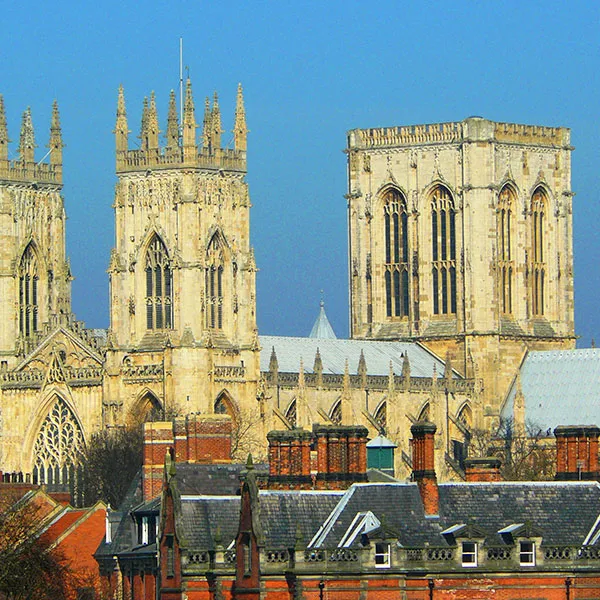
The next track is the glorious sound of York Minster. Canon Nolloth, who was Canon of the Minster, was instrumental in getting the old bells recast by Taylors in 1925. These are our heaviest, harmonically tuned peal of bells. The two west end towers of York Minster contain no less than 56 Taylor bells, the ringing peal of 12 plus two semi-tone bells, an 11-bell chime which was transferred from St. Mary’s, Nelson, Lancashire, a carillon of 35 bells, which was created by adding a further 24 bells to the Nelson chime in 2007, a six bell clock chime installed to mark H M Queen Elizabeth, the Queen Mother’s 100th birthday in 2000, and Great Peter. The combined weight of all these bells totals more than 40 tons.
The band is ringing 3 leads of Littleport Little Surprise Maximus.
Play York Minster, North Yorkshire

Shrewsbury, Shropshire
Next, the 12 bells at St. Chads, Shrewsbury, which is the largest round church in the country. In 1914, the old Mears peal of 12 were recast and installed in the original Mears 1798 wooden frame. These bells are our first harmonically tuned complete 12.
The band is ringing a plain course of Erin Cinques.
Play Shrewsbury, Shropshire
Peals of 6 & 8 Bells

Buckland Brewer, Devon
This track features the ground floor peal of 6 at Buckland Brewer near Bideford in Devon. This village has historic links for Taylors as there was a branch of the foundry here between 1825 and 1834. This peal of bells was cast in 1899 and were re-hung on ball bearings in 1937. The normal Devon call change peal of 60 on thirds took 20 minutes so the band rang a shortened version.
Play Buckland Brewer, Devon

Harpole, Northamptonshire
This is Harpole in Northamptonshire. These bells were cast as a 5 in 1930 and are typical of the quality of so many Taylor peals installed between the wars. This era is considered by many to be the heyday of the company. However, the seamless addition of the new treble in 1994 proves the high quality of our work continues today.
The band is ringing a plain course of Beverley Surprise Minor.
Play Harpole, Northamptonshire

Castle Acre, Norfolk
Next, the bells of Castle Acre, set in a picturesque village in Norfolk. The old 5 bells were recast in 1951, and a treble was added to give the peal of 6. These bells are typical of those tuned by Paul Taylor in the early post-war era.
The band is ringing a 60 of Grandsire Doubles.
Play Castle Acre, Norfolk

Brewood, Staffordshire
This is the peal of 8 at Brewood in Staffordshire. These bells, which were completed in the works on the 22nd June 1896, were the first complete peal cast after the installation of the tuning machine at the foundry, which allowed Taylors to explore the art of harmonic tuning. Although some of the bells didn’t quite achieve harmonic perfection, they are a taste of things to come and represent a marked step forward from the bells cast prior to this time.
The band is ringing 3 leads of Spliced Surprise Major consisting of Rutland, Superlative and Rutland.
Play Brewood, Staffordshire

St. Stephen in Brannel, St Austell, Cornwall
This features the bells of St. Stephen in Brannel in Cornwall. Cast in the early 1900s, this ground floor ring of 8 has to be one of the best of an excellent selection of Cornish Taylor peals. The steel grillage has recently been restored when it was discovered that the steel girder base had rotted through.
The band is ringing a bob course of Stedman Triples.
Play St. Stephen in Brannel

Chewton Mendip, Somerset
Now we feature Chewton Mendip in Somerset. Cast in 1913, this peal of bells has long been considered by many as the definitive peal of 8. The richness of sound, heard both inside and out, demonstrates that when good bells and good tower acoustics are combined, the sound produced is of a very high quality.
The band’s ringing 3 leads of Bristol Surprise Major.
Play Chewton Mendip, Somerset

Stedman Triples
Here we hear Stedman Triples being rung on the largest eight bells of the magnificent peal at York Minster. These bells, cast by the renowned John Taylor & Co. bell foundry in 1925, are celebrated for the exceptional richness and clarity of their tone. As a method of change ringing, Stedman is one of the oldest and most enduring patterns, originating in the 17th century. It has been performed by skilled teams of ringers for over 350 years, requiring precision, rhythm, and deep coordination. When executed on the York Minster bells, the resonant harmony of Stedman Triples combines historical tradition with acoustic beauty, echoing through the vast gothic space in a display of both musical and architectural grandeur.
Play Stedman Triples
Curious to hear more?
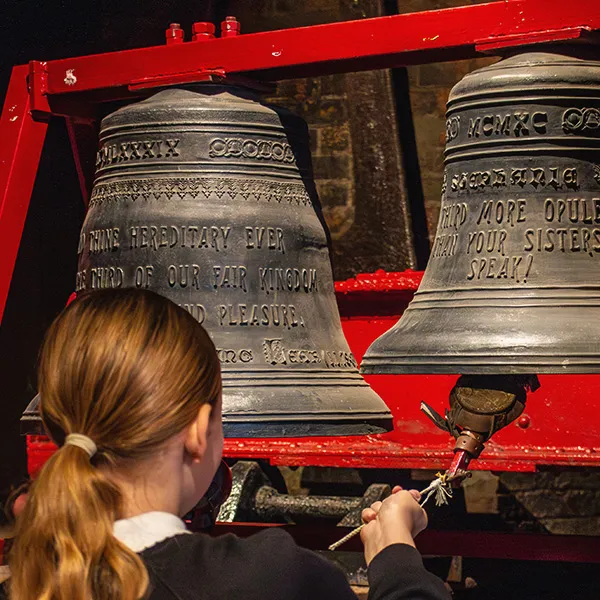
Discover the story behind Taylor bells with a guided tour from our friends at the Loughborough Bellfoundry Trust, or explore the on-site museum where you can get hands-on with some of the historic bells and hear them for yourself. While the Foundry and the Trust are separate organisations, we work closely together to protect and share this extraordinary legacy.